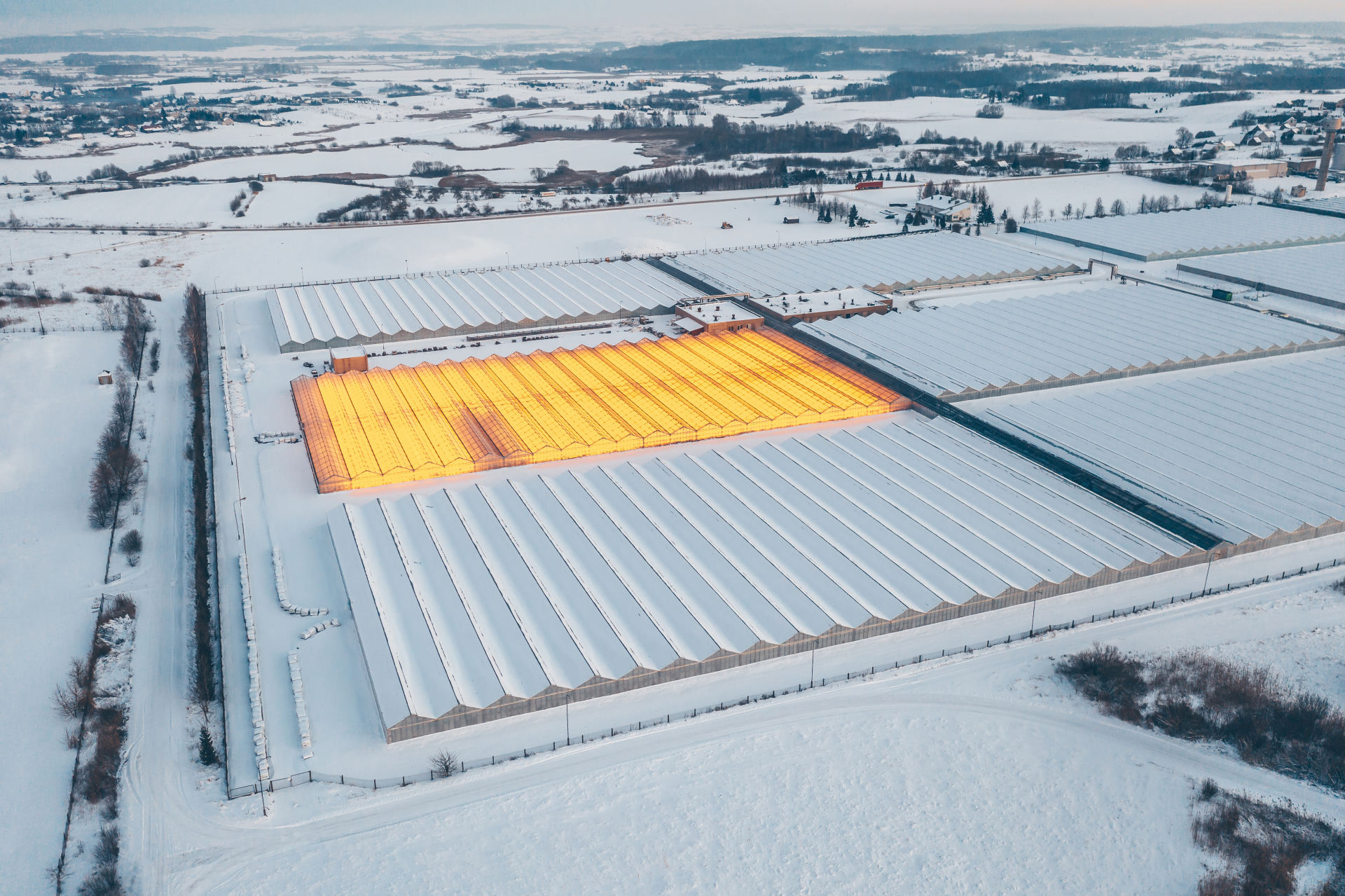
Ah yeah, in the post's first "unknown light pollution" example, I figured it must be a greenhouse. I was driving through a relatively small town one time and was a bit freaked out by this ominous yellow glow off in the distance. Like, the whole sky was glowing [0]. I ended up driving out to try to find the source, and discovered it was a huge greenhouse/farm. Luckily not an extraterrestrial landing zone or so on ;)
I've lived relatively close to one and hadn't seen night's sky for the whole duration I stayed there. Actually the whole town's sky was filled with light polution from one cucumber farm.
I was having problems with my cable internet periodically dropping out for a few minutes at a time, it took them two or three tries, and every time the support guy came out they were very careful to tell me that "your neighbors grow lights may cause that when they switch on at some particular time every night". So I guess they do put out quite a bit of RF noise ;)
("of course, it's company policy never to imply ownership in the event of a dildo.")
Think it was a firmware bug in the modem, because the modem never realized it was offline or showed a connectivity disruption on the street. Luckily it dropped off one time while I was on the phone with a tech. They were using a new Charter Spectrum branded modem and as soon as they swapped to an Arris it stopped happening.
Photo caption says LED. That color is common for them, or even a mix of blue and red. When going LED they only use ones with the wavelengths the plants actually use. You also see this in articles covering vertical farming prototypes. And when i think about it, this is nothing new, because i remember people
growing exotic plants in their windows in not so exotic germany, often had 'plant-lights' with that purple sheen to support growth. That was decades ago, done with flourescent tubes. Nowadays it looks like this:
> When going LED they only use ones with the wavelengths the plants actually use.
And those wavelengths are...everything except green. You can tell this because plants are green, because they reflect green light and absorb everything else. So an LED-lit greenhouse looks "anti-green", which is some kind of reddish purple. It's a bit more complicated than this in practice, but not much.
I bought some of these dedicated wave length LED grow lights once winter. The color is so off-putting that I built a grow tent around them. Event the cats quit using that part of the house before I made the tent. However, the plants sure loved them. I had a couple of potted citrus trees that started blossoming after a couple of weeks inside under these lights. The house smelled amazing. Wasn't worth the loss of square footage in the house though.
There you go again using logic. Besides, I had to at least let the lights work long enough to see if they worked. In the end they did. They're just not friendly for home living aesthetics.
I wonder how much money might be saved just by installing shutters to reflect the light (and heat) back into the greenhouse instead of letting it pollute everywhere.
Light perception is logarithmic. There might well be 99% of the light hitting the plants leaves, and 1% escaping to the environment, yet that 1% will only appear a bit dimmer than the original light source.
Purple makes sense. Blue and red are the colors of light that are most effectively absorbed by chlorophyll-pigmented plant leaves. Yellow would be a lot less efficient because more would reflect off the green leaves.
Ah yeah, that's exactly where I got the above photo from. The purple glow is ridiculous! At least the yellow is a little less "abrasive" and more natural-looking.
There is research on whether solar arrays would be a net benefit. Those cells would catch most of the sun’s light, turn it into electricity to power the LEDs that have wave lengths that are better matched to what the plants need.
Mass produced photovoltaic is 22% efficient. LEDs tuned to the plant are 50% efficient. Net efficiency 11%. Now you need 9 times as much land to grow the same number of plants.
Plants reject a lot of the visible spectrum. The question is, can you make up for the losses in solar panels by giving plants light that they can use more efficiently?
Maybe it's to do with having to peel it back during the day? Should be quite an increase of mechanical complexity compared to just switching the lights on and off
Pulling a shroud over the roof at night is standard practice in passive greenhouses in China. It dramatically reduces heating costs. I’d guess it would reduce lighting costs as well.
Anyway, the necessary mechanical systems exist and are produced/deployed at scale.
Maybe US regulators should step in and require light / heat shielding at night above a certain size.
It looks even more amazing when it's cloudy and the ground is covered by snow. You can go skiing in the forest at night and you won't need any additional lights.
I got the train from Hanoi to Ho Chi Minh city last year - the length of Vietnam.
I was struck by the phenomenal degree of light pollution the dragonfruit plantations made - huge arrays of incredibly bright lights, illuminating the sky and area for miles around them in a brighter than moonlight glow.
Similarly, while at sea in the Andaman and gulf of Thailand, the entire horizon is dotted with the bright sparks of squid boats, which use huge lighting arrays as artificial moons to attract squid.
Between the smog and light pollution, it’s a wonder there’s any night sky at all in SE Asia.
I flew through the night to Singapore once. I remember two very striking light sources.
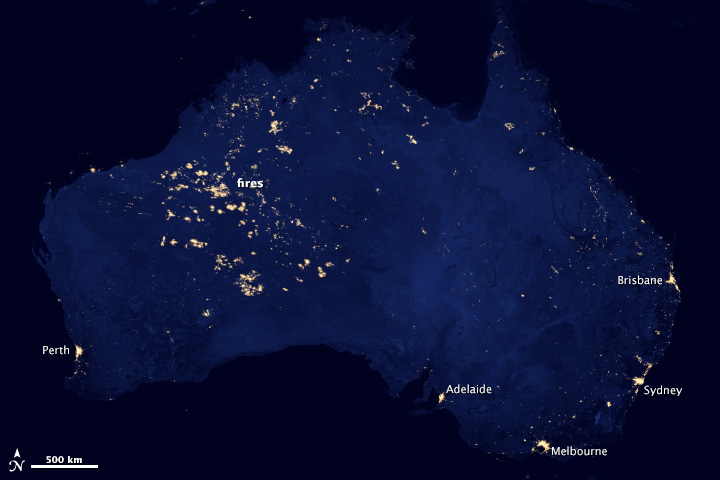
Firstly, oil well flares in the Middle East. The oil fields are in the middle of nowhere, so they're these huge orange-red blooms set in utter darkness.
Secondly, Delhi. The city is brightly lit with streetlights. But there's a suburb (?) to the south, Faridabad, that's as brightly lit, but with a different, whiter, kind of lights. So you had these two huge blotches of yellow and blue light projecting into each other. There are also some extremely bright areas to the south of the city - after some investigation, I decided they were probably rock-crushing plants.
Chicago has been slowly replacing its yellow sodium streetlamps with efficient LEDs that project down instead of up. They've been working block-by-block in a systematic way that you can see when you fly into the city at night. It's quite dramatic.
Same with my subdivision, the local power company made a pass a few years ago and replaced every other street lamp with a LED. They also took the old larger lens covers to.
The first observation was the it was like living with nearly a full moon out all the time; this increased after all lights were replaced. They produce very clean light which appears to reflect more than the old orange light color. the second was that birds in my front holly bushes and thuja trees took some time adapting to the newly lit world; at first they sang/chirped at night hours.
LED lights are amazing for efficiency to the point light pollution will increase simply because it cost so little to keep the lights on; I know I am guilt of that around Christmas as I run nearly five hundred feet of LED lighting then and don't even see the effect on my bill
I was looking around in that area (on the maps) and apparently its an oil field kind of thing. Reading up on it, there's restrictions on being able to actually access the ocean from that location - concerns about security, I guess.
I thought an interesting nearby spot (east of Prudhoe Bay) was Cape Parry Bird Sanctuary. On the west side there was a military base that had since been decommissioned and what looks like an abandoned airstrip. But it still is bright for that area.
Apple Maps shows more detail for that location; maps.google.com didn't have very high resolution imagry.
As someone working in the greenhouse lighting industry, I might have some insight on this:
1. there is an existing technology called energy screen/curtain, with the primary function of retaining heat, but can also reduce light pollution by an order of magnitude.
2. light that escapes is essentially money lost, however it alone does not justify the use of energy screens.
3. as long as farmers have access to (relatively) cheap heat and electricity, they won't invest into this technology.
4. for the time being, it's a regulatory issue, just like water use (a single plant use 2-2.5 l/day), supplemental co2 use and nitrate recirculation from runoff water.
In addition to wasting energy, light pollution at night is killing off insects, which (along with other factors, like neonicotinoids and habitat loss) is leading to ecosystem collapse.
For instance, North America’s bird population has dropped by 25% since 1970. Insects fared significantly worse over that period, but exact numbers are harder to come by.
Water use and nutrient recirculating can be lowered dramatically with aquaponics, even CO2 use can be lowered in some configurations. It comes with added complexity and capex, but should be financially sustainable.
that's per a single tomato plant, summer time. I guess it's the same for any greenhouse crop, see the reasoning here:
water use is necessary to manage internal climate. the greenhouse was designed to keep heat inside. the plants have to cool themselves (hence the environment) by evaporation. the farmer manages evaporation rate by watering, temperature and humidity. there are many feedback loops, both negative and positive, balancing it is a non-trivial task.
btw. there's an average of 1.2-1.3 plant/m2 in most tomato greenhouses I've seen.
Ah, thanks for the clarification. I was shocked at how large a number it seemed, but I only factored in how much water the plant itself displaces in its structure, not the maintenance water to maintain humidity, temperature, etc.
You'd think they'd do better at containing the light from the grow houses, so more ends up on the plants and less making it to space. Like, foil or something?
Since these are greenhouses they have to be clear to let the light in during the day, I assume.
Anything that's going to reflect light to prevent it from leaving at night will also block the sun from hitting the leaves during the day, unless it's a complicated mechanical system that can be folded up during the daytime.
I'm guessing such a reliable mechnical system together with maintenance is much more expensive than the light leakage.
There are systems on the market that are not too complicated. We have an iGrow system for instance for our greenhouse.
But yes, the covers do tend to snag and such when rolling up and that can be problematic and require maintenance. Definitely though the industry does not seem to have yet embraced automation much.
Greenhouses are early adopters of automation. But they only automate the stuff that actually works reliably. This means watering schedule, fertilizer and light. There are few things mechanical that can go wrong with them, especially the light part. They don't have a hord of maintenance people that have time to fix everything that goes wrong. They might have one person that is doing that beside other things.
I live close to one of the bigger ones in north Sweden. They run some accelerated daytime schedule in the darkess of the polar winter so at least part of the nights has a yellow sky in the whole area. You see it for 10 km on the way to the village nighttime. Could almost believe it's a 100 k town but no :-)
That is insanely expensive compared to the more standard poly that gets used, and something as simple as a hail storm night shatter the glass and ruin an entire crop.
I imagine some cheap opaque sheet metal, solar panels and 24/7 artificial lighting would be cheaper than mega-greenhouse amounts of specialty glass.
Foil isn't as reflective as one would guess. Mylar or even matte white painted surface are better.
It really surprises me, too. I guess the sheer size of these operations make it difficult or impractical. The cost must be greater than that of the wasted light. Too bad, because that is a lot of wasted light.
I was looking at light pollution maps just the other day, trying to find places to do astro-photography, and was blown away by how much light pollution there is. Really sucks, because I'd have to drive about 90 minutes out to get into a dark zone.
Only 90 minutes? For me it's at least 3 hours to get to Class 4 on the Bortle scale. Class 2 is probably more than 5 hours. Only alternative is the sea.
I'm planning to take a trip to a Class 1 this summer, it'll be hard to find a place that dark that is reasonably reachable though.
Exactly, this almost sounds like humblebragging (I know it's not, but still...) I mean, in the whole EU you literally couldn't find a place with Class 1 at all, unless going far-far North into Finland national parks or Norwegian mountains. Makes you hate civilization.
Yes, every time we go visit my mother we stop on the road and look up, it's beautiful. No villages for 15 km and only darkness around. And a car passing by with ten headlights blinding you every now and then...
Go to an island and hope the power goes out. I was on Cayman Brac (a tiny Caribbean island) during a power outage, and even though there was a full moon, the view was amazing. Then there was a lunar eclipse that I hadn't even known about in advance. Most amazing sky I've ever seen.
Islands tend to be pretty close to water/ocean. The moisture in the air has always played havoc with my attempts at imaging from these locations. My bucket list destination is Atacama.
Darksitefinder scores a good portion of the remote North Cascades in Washington a 2 on a 1-15 point scale, which is ~4.5 hours from Seattle during winter (with highway 20 closed).
The maps themselves are counterproductive because they attract visitors, who are all idiots. There's a new house some guy built in Mono County in what was a Bortle class 2 area and the whole house is surrounded by up-pointing lights because I dunno, it looks better that way on the AirBnB listing I guess?
On https://www.lightpollutionmap.info/ there is a big pollution area in Russia, North of Khazakstan. There doesn't seem to be a city. Is this an oil field? One of the patches is at 67 degrees 42' N, 83 degree 47' E.
A lot of fracking sites near me have exceptionally bright lights at night when they're being actively worked on. I suspect the brightness shown might be regular old electric lights, not just gas flares.
Car parks are notorious light polluters as well. These are large parking lots where car manufacturers off load cars by rail for their "last mile" delivery to the area dealerships. The lights are meant to keep the thief away. On top of the horrendous light pollution, they also cause massive* traffic headaches where the trains can come to a complete park for 20-30 minutes while the train cars with autos are connected/disconnected.
*The one I lived near was in a pretty small town, so the traffic might have been only 10-15 cars on either side of the tracks. Massive is directly proportional to your direct involvement of being stuck.
I don't know how they remove the automobiles from the train cars. This isn't what makes the train stop. It is the disconnect of the train cars with automobiles from the train so they can be moved to another set of rails that lead into the car park.
One thing I'd like to see is a light-pollution map of the US overlaid with a map of all US federal land. To answer the question: what's the brightest thing the federal government is doing?
Several years ago I noticed that the northern edge of Alaska was lit up like Vegas on one of these light pollution maps.
I was very curious what the heck this was and took to Google Maps. Found that it was oil fields as well. I'd personally assumed lighting for workers however and not gas flares.
The map of the United States raises an interesting question. There is a pretty distinct line down the middle, with nearly opposite light/dark patterns on different sides of the line.
To the east, it is mostly bright areas with islands of dark. To the west, it is mostly dark areas with islands of bright.
If you look at a regular map, nothing really stands out to explain the difference. It is not like there is, say, a mountain range or difficult to cross river or something running down the boundary that made travel or settlement westward much more difficult at that point.
So why did patterns change there?
I asked about this once before, and received a few answers. I'm not sure if any of them are the actual explanation or not, though [1].
I believe it's the beginning of the Great Plains and generally lacks water. It's not dry like a desert, but compared to the temperate forests and rivers of the East, South, and Mid-West, it is. It is intensively farmed now, using pumped aquifer water (https://en.wikipedia.org/wiki/Ogallala_Aquifer), but it never developed the population density of the East. Geology maps also show this divide, so it is based on the underlying rocks, as well as weather patterns from the Rocky Mountains I suppose.
Curiously this lines up with the locations decimated by the Dust Bowl [1]. There was a mass migration of millions of people westward towards California during the 1930s once the agricultural industry there collapsed.
The proximate cause for that line might be farming techniques poorly adapted to the prairie ecosystem which caused a massive ecological collapse.
My guess would be that the land is not as conducive to farming west of that line, both in terms of soil and weather. So early settlements didn't occur there, and thus cities did not emerge from those areas.
The cities that did evolve in the West were based on different resources: ports around the ocean, mining, oil, railroad stops etc.
I think that explains the immediate effect. You can of course then wonder why the population is distributed that way, but I feel I've done enough here :)
>Yeah, there is a pretty distinct line from Winnipeg to San Antonio, separating light from dark.
That's the I-35 corridor. An interstate highway running north/south all the way from Mexico to Canada. It was probably the most hyped/utilized part of NAFTA. I live in Dallas where I-35 runs through (actually splits in Waco to cover both Dallas and Ft. Worth, reconnecting north around Denton). I grew up in a small city south of Dallas, and remember all of the highway construction that got spurred by NAFTA. That area (Ellis county) also had a construction boon due to the Super Conduction Super Collider.
> Beginning in May, 2018, the lava lake that existed inside Halema‘uma‘u crater disappeared and lava flows from Puʻu ʻŌʻō crater have ceased. There is no molten lava or lava glow to see anywhere in or out of the park.
(I would still recommend visiting: the road that encircles the volcano is destroyed, and parts of it are hike-able, and the destruction is fun. And the caldera is even bigger now, and the sulfur vents are interesting, and the landscape is beautiful. And Hawaiʻi is just breathtaking.)
Constellations of fishing boats can also be a significant source of light when viewed from space. Here are examples from NASA of fishing boats off the coasts of Argentina [1] and Thailand [2].
I live on the other side of Earth but can fully sympathize with your long drive. It’s a shame that the Milky Way is so difficult to see in most cities around the world. It is truly majestic: not only visually stunning but also awe-inspiring when you realize you’re gazing across the void at the next arm of our galaxy.
Light analysis is surprisingly noisy.If you want to do it right, you have to screen out or control for cloud cover, reflections, moon light, oil well fires, and also account for satellite position and the local time at night the image was originally taken. The first four, particularly the first, are easier said than done (e.g., still waiting for NASA to publicly release VNP46A2).
Here in Canada, many tomato greenhouses have been converted to cannabis greenhouses. Some areas have lost their night sky because of this, as they have all grown quickly and use the same kinds of light arrays discussed in this article.
Do they really need yellow? Plants do not really need green light (that's why leaves usually reflect green they don't need), so they'd probably be ok with red/blue lamps only. So why yellow?
You'd probably be right if they were only concerned with the growth of greenery. It's possible that the light needs of a flowering/fruiting tomato plant are different. It's also likely that the work of the humans and the bees is easier in something closer to daylight.
I can't figure out one light pollution source in Poland in Sluchowo (54.77550N, 17.94972E). The map from 2015 shows some factory of sorts, but it disappears on the map from 2020, all you can see is an outline what it was. I really wonder what kind of place this was and why it emitted relatively a lot of light.
Most likely some kind of military operation. It could be a storage site, guarded 24/7 where light is important so the guards can see everything clearly.
Is this just tradition? Surely a computer system can see/hear, maybe using night-vision (lidar? radar?), way better than guards can. Then lights can activate and guards can shoot at anyone unwanted who crossed the perimeter .. surely enough incentive?
Used to be a huge bright spot way the hell north in Canada, on one of the islands. I finally IDed it as an enormous open-pit lead mine. The site was finally mined out after producing millions of tons of lead.
What are all the light sources in the ocean between Taiwan and South Korea? I'd assume shipping, but what about the other shipping lanes, those don't look so obvious compared to that piece of ocean



[0] looked like this https://i.cbc.ca/1.4925044.1543460834!/fileImage/httpImage/i...